join the next adventure
Join a growing network of curious explorers. Get early access to new trips, insider updates, and connect with people who share your drive for adventure.



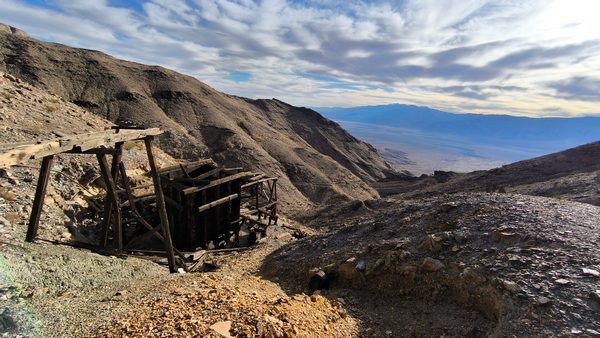
The Keane Wonder Mine closed in 1912. More than a century later, it is still standing — not as a ruin, but as something closer to a time capsule. Death Valley's exceptional aridity does what no preservation budget could: it keeps wood from rotting, metal from rusting at the usual pace, and history from quietly disappearing. Some recent structural repairs have been made to keep it safe for visitors, but most of what you see is original.
We visited in late November, which turned out to be ideal. The heat of a Death Valley summer would make this a very different — and significantly less enjoyable — experience. The one trade-off: short winter daylight limits how much ground you can cover. If I were doing it again, I'd arrive even earlier in the morning.
Death Valley's dryness does what no preservation budget could — it keeps history from quietly disappearing.
Reaching the mine requires driving an unpaved gravel road to the parking area. It looks manageable in a passenger car, though every vehicle we saw there was an SUV — probably not a coincidence.
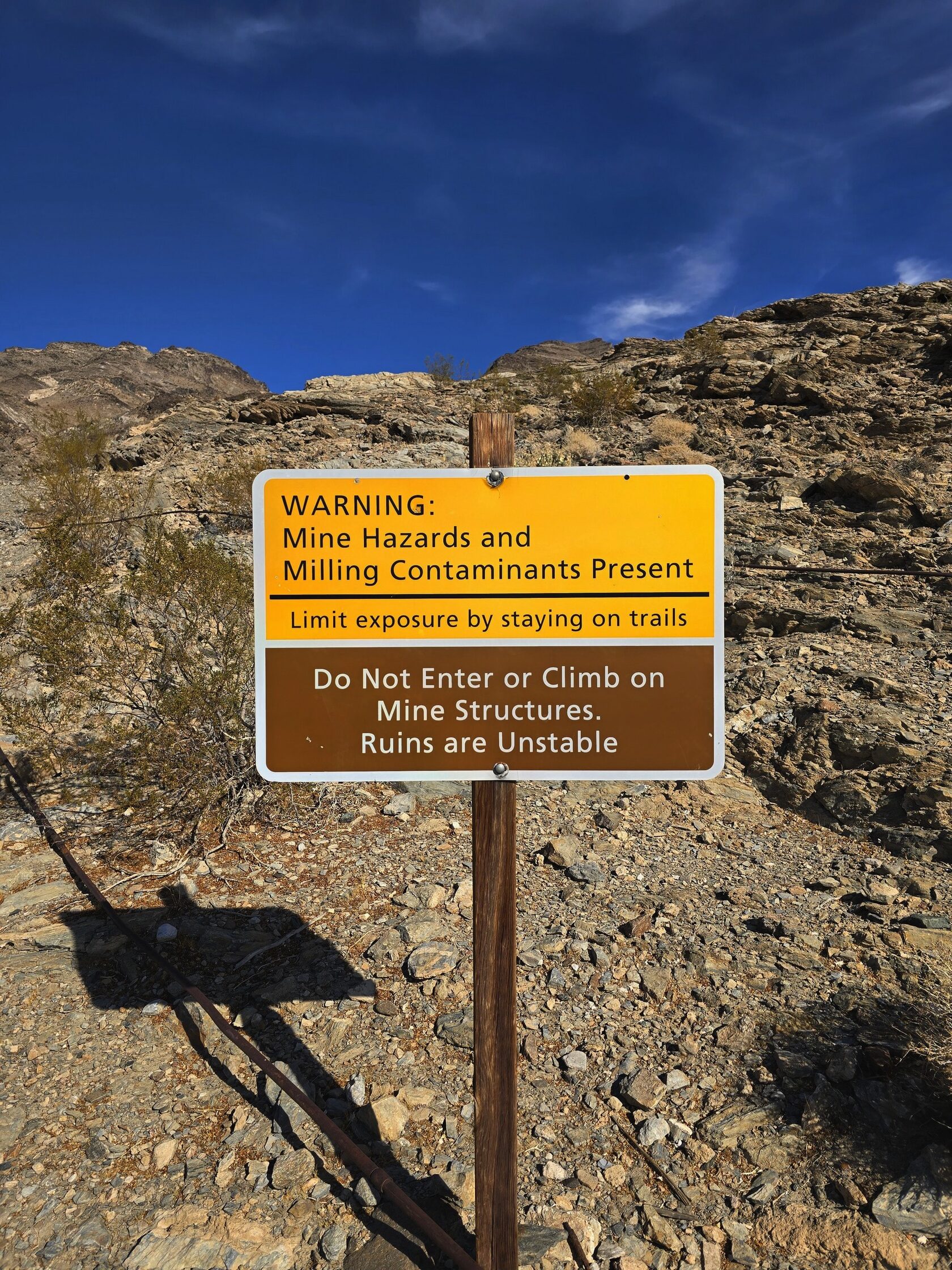
As you'd expect from an abandoned hard-rock mine on federal land, there's a prominent NPS warning about site hazards. The mine entrances themselves are sealed with heavy steel bars — not the kind you're going to move. This isn't access theatre; the shafts are genuinely dangerous.
.jpg)
There is a well-maintained out-and-back trail of around 13km with nearly 700m of elevation gain. It's a solid hike and perfectly worth doing. But the more rewarding option — if you're comfortable with a bit of scrambling — is to take the dry creek bed that starts to the right of the lower aerial tramway terminus.
We went up via the creek bed and came back down on the official trail, which gave us the best of both routes.
.jpg)
The creek bed route takes you up and over a series of dried-out waterfalls. None of it is technically demanding, but it does involve some genuine scrambling — climbing up ledges, finding the line around drops. If you're uncomfortable with heights or have no experience moving on rock, stick to the official trail. For everyone else, this is the highlight of the day.
Along the way, the creek bed delivers a steady stream of artifacts: old ore carts, cogwheels, cable hardware, and pieces of machinery that have simply been sitting there since the mine shut down. If you want a closer look at the aerial tramway structures themselves, you can leave the creek bed and climb up to them — it's worth the detour if you have the energy.
.jpg)
.jpg)
One of the stranger finds: a colander-like device that appears to have been fashioned from an old tin can. Whether it strained something, filtered something, or served some other purpose I couldn't work out — but it's a good example of the kind of improvised ingenuity you find throughout the site.
Higher up, near the upper terminus of the aerial tramway, there's what can only be described as an ancient garbage dump. It consists almost entirely of empty tin cans — presumably the remnants of the miners' food supply. The complete absence of plastic is its own kind of timestamp. This rubbish is over a century old.
.jpg)
.jpg)
We also came across a galvanised washtub in remarkable condition — the kind that, cleaned up, you could probably still use. It reminded me of something my great-grandmother had in her house in a remote village. There's something quietly affecting about finding an ordinary domestic object in a place this remote and this old.
Further along: ore carts in much better shape than you'd expect, built to last and having done exactly that.
.jpg)
.jpg)
.jpg)
The upper terminus of the aerial tramway is the mechanical heart of the site. The machinery is largely intact — pulleys, cables, drive mechanisms — and you can see what appears to be the original electric motor that powered the whole system. Standing next to it, knowing it hasn't moved since 1912, is one of those moments that makes the history feel real rather than abstract.
There were additional structures further up the mountain that we didn't reach — sunset was coming and we had a descent to manage. That's fine. It gives us a reason to come back.
Standing next to machinery that hasn't moved since 1912 makes the history feel real rather than abstract.
.jpg)
.jpg)
We descended on the official trail as the light turned golden, which turned out to be one of the better decisions of the day. The views looking out over Death Valley at dusk are genuinely spectacular.
Keane Wonder Mine is one of the best day trips from Las Vegas — about 2.5 hours from the Strip. My main advice: leave early. Daylight is limited in winter, and this is a place that rewards time. Don't rush it.
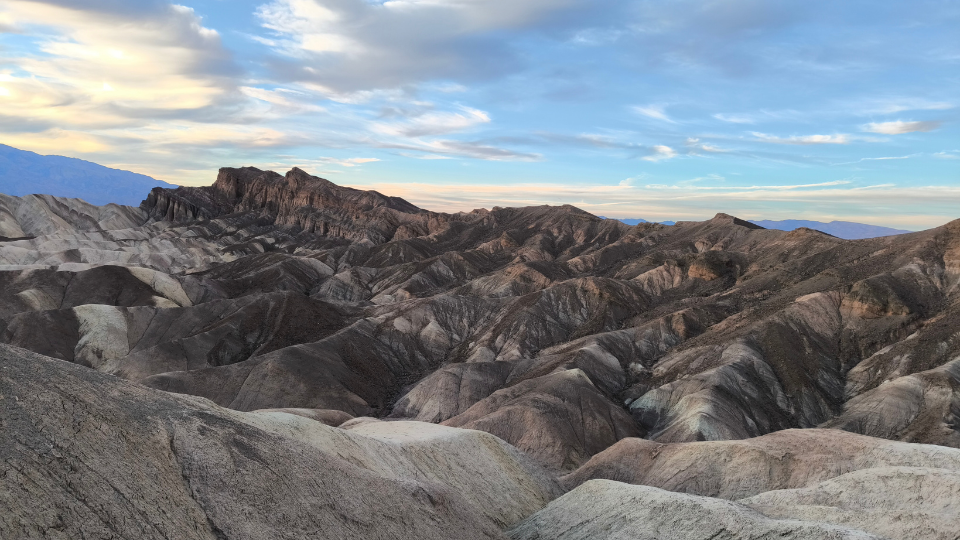
On the way back, Zabriskie Point is worth a stop — one of Death Valley's most iconic viewpoints, and particularly good around sunset. It pairs well with a day at the mine: history in the morning, geology in the evening.
We send something when there's something to send. Upcoming climbs, open spots, and the odd story worth your time.
Patrick Galbraith on the Tour de Abyss, a class 3-4 scramble linking Mount Bierstadt and Mount Blue Sky through Colorado's Abyss Basin.
Twelve geeks extended Percona Live with an e-bike day through Waterland, a guided Badhus sauna, and a paddle down the Amstel.
Seven geeks, one week in Alta Badia: the Crëp de Sela hike, via ferratas Les Cordes and Tridentina, and a night in the highest rifugio in Italy.