join the next adventure
Join a growing network of curious explorers. Get early access to new trips, insider updates, and connect with people who share your drive for adventure.
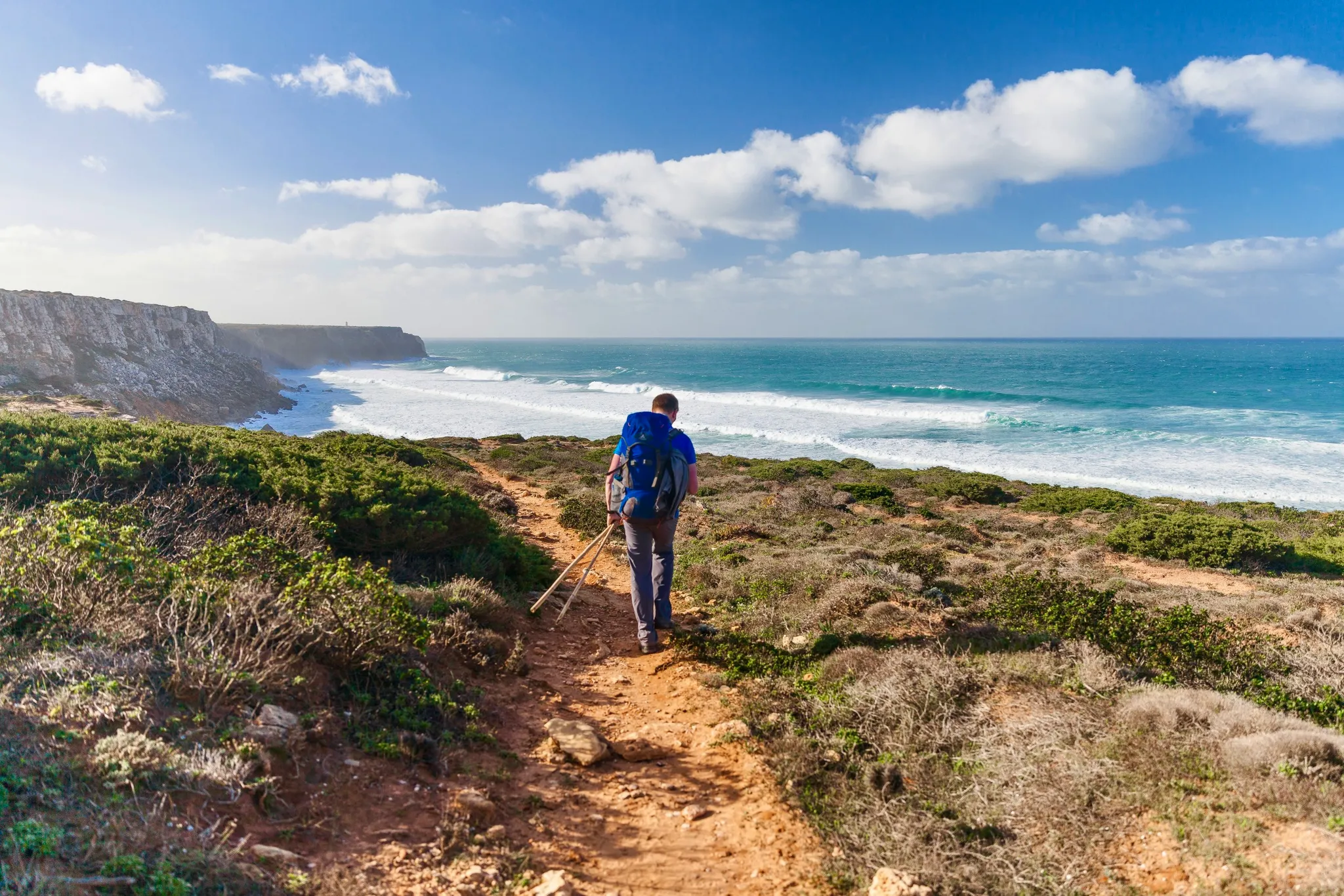
Nobody built this trail. It follows Portugal's southwestern coast through a UNESCO-recognized area where cliffs drop into the Atlantic and storks nest on sea stacks – like nowhere else on Earth. It's wild, uncrowded, and stays mostly on single-track and sand — which is what makes it harder than it looks. Daily distances run between 10 and 22 km, but walking on sand all day is a different proposition from a standard mountain hike. Solid baseline fitness going in matters.
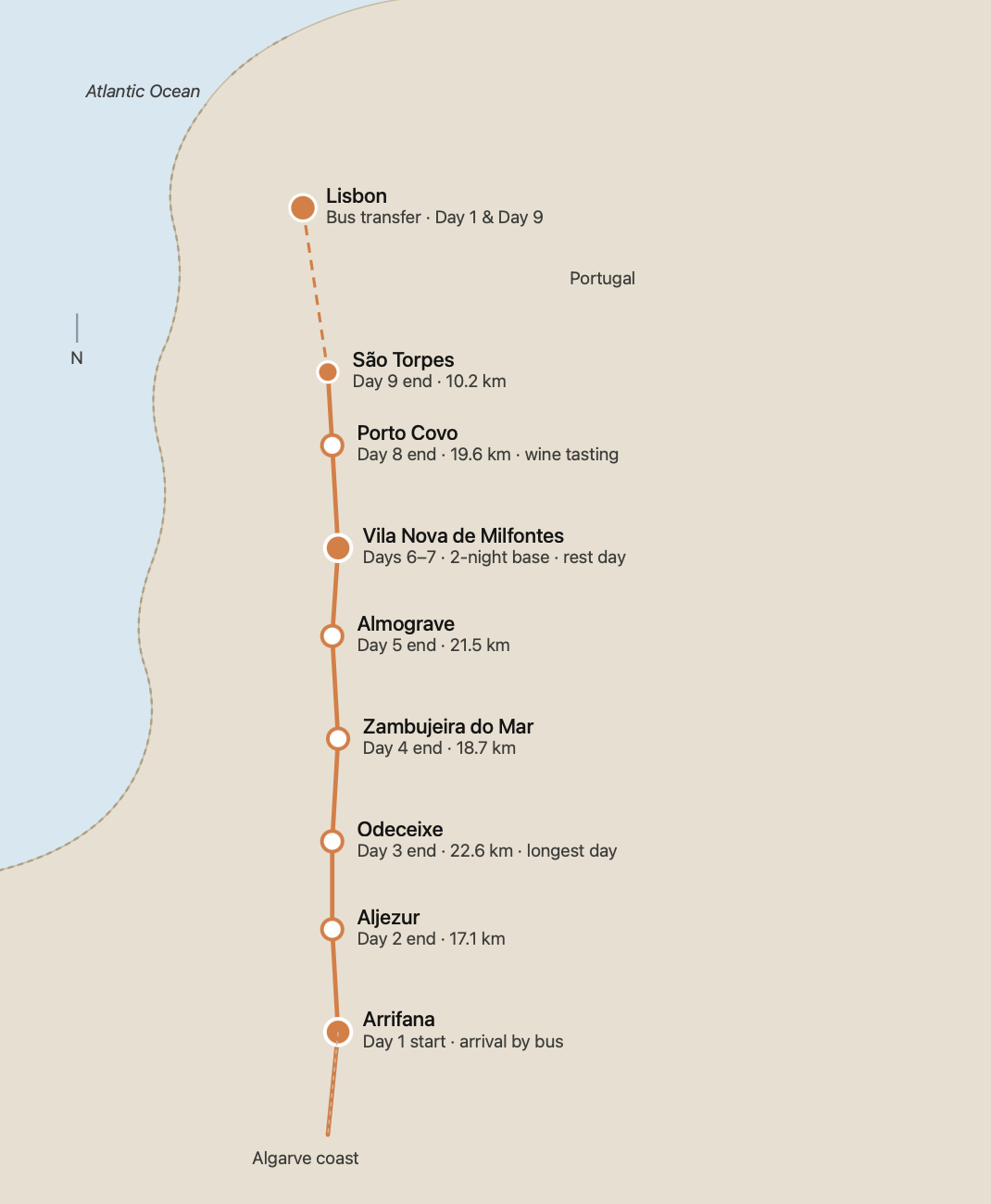
The route runs north from Aljezur through Odeceixe, Zambujeira do Mar, and Almograve before settling in Vila Nova de Milfontes for two nights. The rest day in Milfontes: morning canoeing on the Mira estuary, an afternoon bodyboard lesson on the beach, and no bag to repack. The last two days push north to Porto Covo — a whitewashed fishing village that still functions as one — and finish at São Torpes beach before the transfer back to Lisbon.
Small guesthouses, local restaurants for every dinner, luggage moved for you daily, two certified guides on trail. October is the right window — the summer crowds have cleared and the coast is at its most itself.
Fly in, meet the group, sleep in the city. No walking.
This exists because flights land at inconvenient hours and starting a nine-day walk on four hours of sleep is a choice people regret. Dinner together.
Private bus south. Aljezur has been occupied more or less continuously since the Iron Age — Conii, then Romans, then Visigoths, then a Moorish settlement in the 10th century that built the castle whose walls you can still climb. The Order of Santiago took it in 1249; the 1755 earthquake flattened everything inside the walls except the church nave, and the town rebuilt itself on the other side of the river, which is why the old and new halves face each other across the water.
It's also Portugal's sweet potato capital. The batata doce de Aljezur has EU protected status — the same legal category as Champagne and Roquefort. There is a festival in October. Ask a local about the sweet potato and set aside twenty minutes.
Check in, walk the old town, welcome dinner.
The longest day, taken early.
Out of the valley where seaweed was hauled up from the beach to fertilise the vegetable gardens, onto the cliffs, north. The day ends where the Seixe river meets the Atlantic at Odeceixe — a village of winding streets and stairways climbing to an old mill, sitting above one of the most-loved beaches in Portugal. This is also the border. Behind you, the Algarve. Ahead, the Alentejo.
Cliffs, coves, and the descent into Zambujeira: whitewash and terracotta stacked on the cliff edge above a half-moon beach. The village square is round. Dinner is fish, and if percebes — goose barnacles, prised off the rocks at low tide by people who take real risks to get them — are on the menu, order them once.
The wildest stage. Hours without a village in sight, past the fishing platforms at Entrada da Barca and the lighthouse at Cabo Sardão — the westernmost point of the Alentejo coast, working since 1915. This is the stork cliff.
The nests are built in layers, year over year, and the old ones can weigh a tonne. Red dunes into Almograve.
The short day. Dunes, pine, and the Mira estuary opening up ahead of you. Milfontes was founded in 1485 by King John II, fortified against the pirates who worked this coast for two centuries, and is still called the Princess of the Alentejo by people who mean it.
Two nights here.
A full day off the trail. Morning canoeing on the Mira estuary, afternoon bodyboard lesson on the beach.
Two-night stay means no luggage to repack.
North past Ilha do Pessegueiro, where the Romans ran a fish-salting operation — the island's name traces back to piscatorius, not peach trees.
The fort on the island was started in 1590 and never finished; the engineer got reassigned and nobody picked it back up. Porto Covo means port of the fishing net. After 1755 it was rebuilt on Pombal's grid, which is why a village this old has straight streets: white houses, blue stripes, red shutters, running down to the sea. Wine tasting in the evening.
The gentlest stage, and technically the official start of the trail — you're walking it backwards, and finishing where everyone else begins. Farewell lunch at São Torpes. Bus to Lisbon mid-afternoon.
· 8 nights in carefully selected village guesthouses
· All breakfasts · All dinners at local restaurants
· Wine tasting with a local producer in Porto Covo
· Bodyboard lesson on Milfontes beach
· Canoeing on the Mira estuary
· Private bus transfer Lisbon → Arrifana on Day 1 and São Torpes → Lisbon on Day 9
· Two certified local guides walking the full route
· All Rota Vicentina trail permits and licenses
· Daily luggage transfer between villages — you never walk with your main bag
· On-trail support and emergency coordination
· Flights to/from Lisbon
· Travel insurance (each participant arranges their own)
· Personal hiking gear — boots, day pack, rain jacket
· Alcohol and extra snacks
· Optional spa, surf, or yoga add-ons

The daily average is around 20 km, but most of it is on sand — significantly more demanding than a standard hike. Arrive with solid baseline fitness. Regular hiking, running, or long walks in the weeks before will pay off.
Your main bag is transferred between villages by van every day. You walk with a day pack only (water, sunscreen, rain layer, lunch). One bag per person, up to 15 kg.
Most stages cross long stretches with no restaurants or shops. Each evening you stop at a local grocery store to stock up for the next day. Dinners are always at a restaurant in the village.
8 nights in carefully selected guesthouses and small family-run hotels (3-star equivalent), double or twin occupancy. Villages are small, so the group sometimes splits across two or three nearby guesthouses. Single supplements available on request.
Cristiano and Olha (Popova & Ferreira) — a Portuguese-Ukrainian duo who've walked the Fishermen's Trail village by village.
Both are certified by the Portuguese Tourism Authority (Turismo de Portugal) and carry first-aid kits and offline trail maps.
We’re constantly planning new trips. Join our newsletter and be the first to discover upcoming experiences before they’re announced.

Get early access to Apprify and be among the first brokers to try the new standard of mortgage qualification.